Make a Leaf Boat
A simple outdoor activity for when you are near a stream, pond, river, lake, or even a big puddle.
This is one of those activities that looks tiny from the outside, but once children start, there is suddenly a lot going on. Floating, sinking, balance, design, problem solving, testing, changing, trying again.
You do not need to turn it into a lesson. Just make a little boat and see what happens.
What you need
A piece of bark
A small stick
A leaf
Access to shallow natural water
Optional: extra leaves, twigs, stones, string, scissors, a hand drill, or other simple tools
What to do
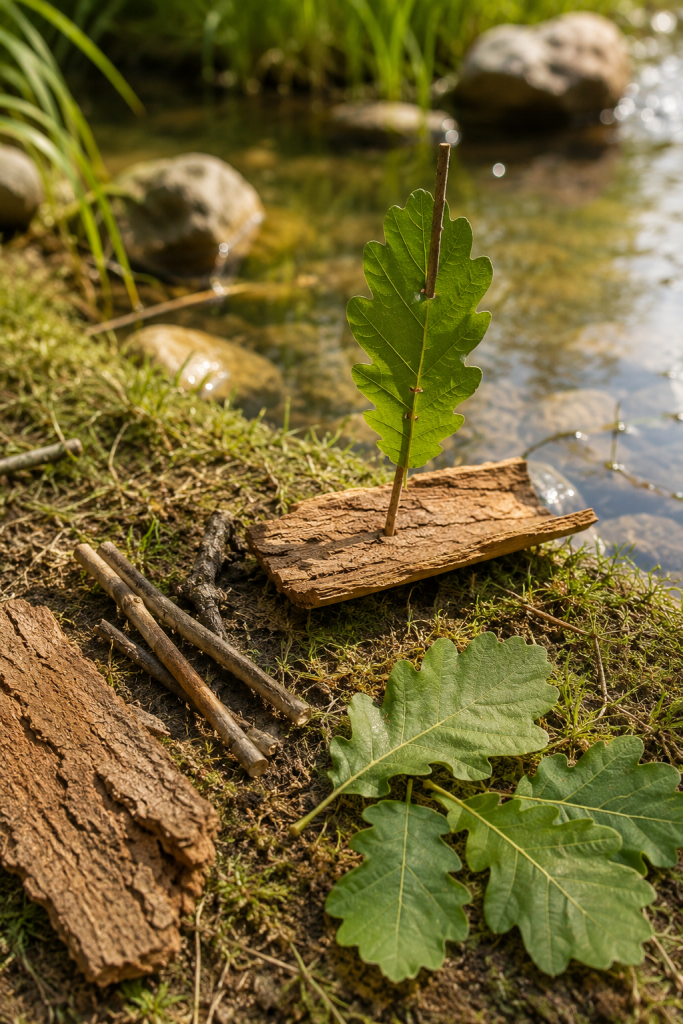
Find a piece of bark that looks like it might float.
Look for a small stick to use as the mast.
Gently poke a hole into the bark using the stick.
Push the stick into the hole so it stands upright.
Thread a leaf onto the stick to make a sail.
Place the boat carefully into the water and watch what happens.
Does it float?
Does it tip over?
Does the leaf catch the wind?
Does it move faster in flowing water?
Does it get stuck?
Let your child test, adjust, and try again.
They might want to make the bark bigger, the mast shorter, the leaf smaller, or the whole thing completely different. That is the best part.
The learning bit
This is simple science and design without needing a worksheet.
Children are exploring:
floating and sinking
balance
materials
wind and water movement
trial and error
simple engineering
problem solving
fine motor skills
They are also learning that the first version does not have to work. A wobbly boat is not a failed boat. It is information.
Adapt it for younger children
For younger children, keep it very simple.
Let them choose the bark, leaf and stick. You can make the hole for them if needed, then they can push the stick in and add the leaf.
They may enjoy simply placing different natural things in the water and seeing what floats.
Try asking:
“Do you think this one will float?”
“Is it moving?”
“Has it tipped over?”
“Shall we try a bigger leaf?”
The aim is not to make the perfect boat. It is noticing, testing and enjoying the water.
Adapt it for older children
Older children can turn it into more of a design challenge.
Try:
Who can make the boat travel the furthest?
Who can make the smallest boat that still floats?
Who can make a boat that carries the most weight?
Can the boat carry a stone, acorn, shell or small toy?
Can you make one using only leaves?
Can you make one without bark?
Can you add a rudder, second sail or cargo area?
Can you use simple tools to make the hole more carefully?
You could also compare materials. Bark, leaves, sticks, reeds, nutshells, feathers, seed pods. Which float best? Which are easiest to build with? Which sink once they get wet?
Simple activity, lots of learning
A leaf boat takes a few minutes to make, but it can lead into a whole stretch of experimenting.
One small piece of bark, one stick, one leaf, and suddenly your child is designing, testing, predicting, improving and noticing the world more closely.