What Home Education Really Looks Like
When people hear “home education”, I think they often picture children sitting neatly at a table, working through piles of worksheets while a parent stands at the front pretending to be a teacher.
But that is very rarely what it looks like here.
For us, home education is much more woven into real life. It’s not a separate thing we do between 9 and 3. It’s part of our days, our conversations, our walks, our meals, our questions, our mess, and all the little moments that don’t always look like “school” from the outside.
It’s playing. Exploring. Cooking. Helping. Meeting people. Asking questions. Getting distracted by something interesting and following it. Learning in ways that make sense to the child in front of you, rather than the age written on a curriculum sheet.
That’s the kind of learning Roam and Reed is built around: real learning, through play, life and connection.
Playing and exploring
Play is one of the biggest parts of our home education.
It might look like building with sticks, making potions, collecting stones, playing shops, digging in mud, climbing, pretending, creating dens, or turning a cardboard box into something completely different.
To an adult, it can look like “just playing”. But underneath it, there is so much going on.
Children are testing ideas, solving problems, negotiating, building stories, using language, developing physical skills and making sense of the world around them. They are learning through doing, which is often far more meaningful than being told something and expected to remember it.
And yes, there is maths and literacy in there too.
It might be counting how many stones they collected, comparing which stick is longest, reading signs on a walk, writing labels for a pretend shop, recognising numbers on a game, or working out the Mario Kart scores to see who actually won.
Those little moments count. They are not separate from learning. They are learning.
Exploring is part of that too. A walk is never just a walk. It can become a lesson in seasons, maps, habitats, weather, road safety, local history, plants, insects, or simply noticing what has changed since last time.
Home education gives us the space to slow down and follow those moments.
Cooking and real-life skills
Some of our best learning happens in the kitchen.
Cooking brings in so many skills without needing to make it into a formal lesson. There’s measuring, counting, weighing, reading instructions, noticing changes, using tools safely, waiting, problem-solving, and talking about where food comes from.
It also gives children something real to be proud of.
They aren’t just completing a task because an adult told them to. They are making something useful. Something they can eat, share, or serve to someone else.
That matters.
Real-life skills are not a side subject in home education. They are part of the whole thing. Learning how to make food, care for belongings, understand money, help around the house, talk to people, and be part of everyday life is valuable learning.
Household chores count too
I know “household chores” does not sound very Pinterest-perfect.
But actually, they are a huge part of learning.
Putting clothes away, helping clean, watering plants, sorting recycling, tidying toys, feeding pets, packing bags, helping with shopping lists — these are all real experiences that build independence and responsibility.
They also bring in everyday literacy and maths in a very natural way. Reading the chores chart. Looking at the calendar to see what is happening today. Checking the shopping list. Counting how many plates are needed for dinner. Sorting socks into pairs. Noticing what time we need to leave.
None of it needs to be forced into a lesson. It is just part of life.
But that does not make it less valuable.
These moments show children that words, numbers, time, lists and routines have a real purpose. They are not just things that exist in workbooks. They help us understand and manage our day.
Household jobs also show children that they are part of a family and a community. They are not just being looked after; they can contribute too.
It’s easy to undervalue this kind of learning because it doesn’t come with a worksheet or a finished craft at the end. But life skills are still skills. Confidence is still growth. Responsibility is still learning.
Meeting new people
Home education does not mean staying at home.
That’s probably one of the biggest misunderstandings.
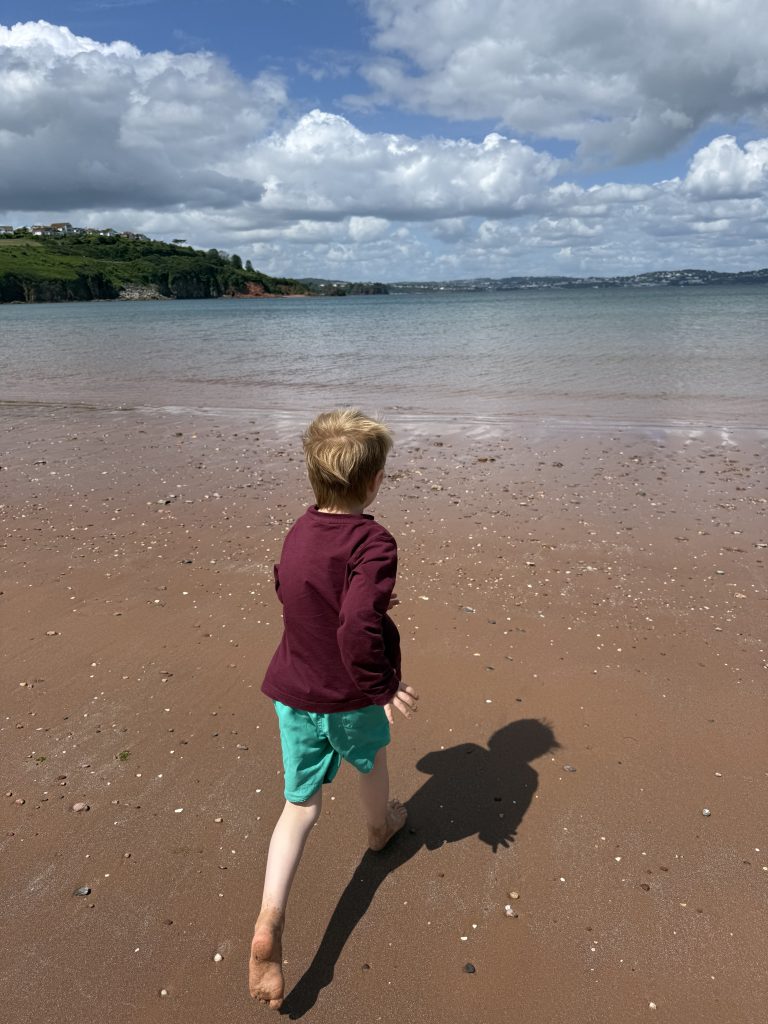
For us, learning happens in libraries, parks, beaches, woods, museums, shops, groups, cafes, family homes, gardens, and wherever else life takes us.
Meeting new people is part of that. Children learn so much from conversations with people outside their immediate family. They learn how to ask questions, listen, wait, join in, speak up, and understand that people have different experiences and perspectives.
That might be through a home-ed group, a neighbour, a shopkeeper, a grandparent, another parent, a younger child, an older child, or someone they meet while out and about.
The world is full of teachers when children are given the chance to be part of it.
Friendships of all ages
One of the things I love about home education is that friendships don’t have to be limited to one year group.
Children can spend time with babies, toddlers, older children, teenagers, adults and elderly people. They can learn to adapt their communication and play depending on who they are with.
That kind of mixed-age connection feels much closer to real life.
In the adult world, we are not only friends with people born in the same academic year as us. We learn from people older than us, younger than us and completely different from us.
Home education can make space for that in a really natural way.
Working outside the box
Home education gives us permission to work outside the box.
That does not mean there is no structure, no learning, or no thought behind it. It means the structure can be shaped around the child rather than forcing the child to fit the structure.
Some children learn best by moving. Some need to talk things through. Some need to touch, build, test and take things apart. Some need time. Some need quiet. Some need to follow a deep interest before anything really sticks.
Home education allows for that flexibility.
A child who is fascinated by insects can learn classification, life cycles, habitats, drawing, writing, measuring, observation and research through that interest. A child who loves cooking can learn reading, maths, science and independence through recipes. A child who loves maps can learn geography, symbols, directions, scale, transport and history.
The learning is still there. It just might not arrive in a neat little subject box.
Learning to interests, not age level
This is a big one for me.
Children are not all ready for the same things at the same time just because they are the same age.
One child might be ready to read early but not ready to write much. Another might be full of big scientific questions but still need support with basic number work. One might be physically confident but socially cautious. Another might have incredible imagination but need more time with practical skills.
Home education allows us to meet the child where they actually are.
Not where a chart says they should be.
Not where a test says they should be.
Not where someone else’s child is.
Where they are.
And then we can build from there.
So, what does home education really look like?
It looks like muddy shoes by the door.
It looks like books on the sofa, snacks on the table, half-finished projects, questions in the car, collections of stones, conversations with strangers, helping hands in the kitchen, and children learning from real life.
It looks like reading the calendar together.
It looks like counting eggs into a bowl.
It looks like checking the score on a game.
It looks like measuring ingredients, spotting numbers, asking questions, making choices, solving problems and joining in with the real world.
It looks like following curiosity.
It looks like connection.
It looks like freedom to grow in a way that makes sense.
It is not one box.
It is not one path.
It is not school at home.
It is real learning, every day.